Elliott Wave
Free Tutorial
Decision Bar

Posts Tagged ‘Robert Prechter’

Why Choose the Wave Principle?

Robert Prechter reveals why he embraced the Wave Principle.

Robert Prechter is the widely recognized authority on the Elliott Wave Principle.

Read how he learned about the Wave Principle and why he embraced it in the edited excerpt from his book Prechter’s Perspective below (Q&A format):

——————–

Question: What was it about Elliott that captured your attention?

Robert Prechter: I had seen some mentions of the Wave Principle in a few market newsletters and a couple of obscure books, and I decided that either this was someone’s elaborate fantasy or it was an amazing discovery. I wanted to reject it from what evidence I could find or include it as part of my growing arsenal of technical analytical methods.

Q: How long did it take you to develop your “eye” for discerning these waves? Read the rest of this entry »

See Prechter’s “FREE FALL TERRITORY” Chart for Yourself

And see EWI’s long-term forecast in the updated “Free Fall” chart

In the May 2008 issue of his monthly Elliott Wave Theorist, Robert Prechter showed this chart of the Dow Jones Industrials. As you can see, prices go back to the 1970s.

Please note that on the day this chart published (May 16), the Dow closed at 12,987 — barely eight percent below the Dow’s all-time high of the previous October.

Yet, as you can also clearly see, Prechter labeled the white space below the May 2008 price level as “Free Fall Territory.”

At the time, no one else dared to publish such a bearish forecast. This was before the Lehman bankruptcy, the bailout binge, the home foreclosure crisis, and certainly before the worst of the stock market collapse.

In his June 2011 Theorist, Prechter published an update to the chart above, and here’s the major difference: The updated chart “telescopes out” by one full degree of trend. Prices go back to the 1930s. The scale of the white space surrounding this chart’s “free fall territory” label will show you what Prechter truly means.

His commentary in that issue also observed that

“the March-April [2011] rally was one of the most passionate bouts of stock buying I have ever witnessed.”

Bob Prechter made this observation not in admiration, but as a warning.

In the past three weeks, the Dow Industrials have plummeted nearly 2,000 points. Most investors are confused and scared. How far down will the decline travel? Will it end tomorrow or go on for years? Read the rest of this entry »

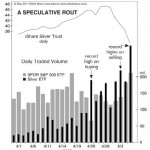
Is It Possible to Have Panic Buying?

What’s up with Silver lately? In this article Robert Folsom shows us what makes Silver tick and how it has gotten so crazy lately.  Tim McMahon, Editor

“Panic selling” is easy to understand and recognize: Investors rush to sell from the fear of loss. No more explanation necessary.

On the other hand, “panic buying” is not easy to see for what it is. The phrase seems to clash with itself. People commonly assume that “buying” involves rational choices by investors, who assess risk, calculate entry points, establish stops, etc.

None of that happens in a panic. So how can you have “panic buying”? Read the rest of this entry »

Slicing the Neckline: A Classic Technical Pattern Agrees with the Elliott Wave Count

In the August issue of his Elliott Wave Theorist, market forecaster Robert Prechter alerted readers that the U.S. stock market was slicing the neckline of a classic head-and-shoulders pattern in technical analysis, and that this may send the market into critical condition.

Prechter said that when the Elliott wave count and a head-and-shoulders pattern are saying the same thing about the stock market, it’s best to pay attention.

Here’s how the August issue of the Elliott Wave Financial Forecast, the sister publication to Prechter’s Theorist, described the head and shoulders pattern unfolding in the stock market: Read the rest of this entry »

Elliott Wave Tutorial


“Successful market timing depends upon learning the patterns of crowd behavior. By anticipating the crowd, you can avoid becoming a part of it.”

I pulled this quote directly from the opening paragraphs of the free Elliott Wave Online Tutorial. It’s critical to your understanding of how markets really work.

Now some might say, “What’s wrong with following the crowd? I’m just following the easy money, right?” The problem with this logic is that most investors follow the crowd (or herd) all the way up the mountain … then right off the cliff.

Look at today’s situation: How many people you know got out of the stock market before the October 2007 top? Heck, how many you know cut losses and cashed out even six months after the top?

 If you’re like most people, your answer ranges from “zero” to “very few.”

 Being a successful investor over the long-term means you must always strive to be part of that “very few.” Read the rest of this entry »

Understanding Robert Prechter’s ‘Slope of Hope’

What's the opposite of climbing the "wall of worry"? Now is a good time to learn why it's called the slope of hope. Read the rest of this entry »

20 Questions with Robert Prechter: Long Decline Ahead

The following article is an excerpt from Elliott Wave International’s free report, 20 Questions With Deflationist Robert Prechter. It has been adapted from Prechter’s June 19 appearance on Jim Puplava’s Financial Sense Newshour.

Jim Puplava: I want to come back to government spending, but first I want to move onto the stock market. In your last two Elliott Wave Theorist issues, you laid out a scenario that would put the Dow and S&P, which in your opinion may have peaked on April 26, as the top from here. You feel that this top is the biggest top formation of all time, a multi-century top and we could head straight down in a six-year collapse that would end in 2016 that could see a substantial portion of the S&P and the Dow wiped out in a similar way that we saw between 1929 and 1933. Let’s talk about that and the reasoning behind it. Read the rest of this entry »

20 Questions with Robert Prechter: Signs Point to Deflation

The following article is an excerpt from Elliott Wave International’s free report, 20 Questions With Deflationist Robert Prechter.

It has been adapted from Prechter’s June 19 appearance on Jim Puplava’s Financial Sense Newshour.

To read the entire conversation, access the 20-page report here.

Jim Puplava: Bob, I want to pick up from last September. Since then we’ve had several quarters of positive economic growth. Asset classes rose substantially, CPI turned positive, gold has hit a new record, oil is close to $80 a barrel. I guess a lot of our listeners would like to know, have these events altered your views on deflation?

Robert Prechter: No, because we forecasted these events, and we forecasted them at the bottom in March and April of 2009. On February 23 in the Elliott Wave Theorist, I said that we were almost at the bottom; that ideally the S&P should get down in the 600s before turning up; and that the Dow was going to rally from that low up to about 10,000. We put that target out a few days after the low. The main thing we said at the time was that it was going to be only a partial retracement, in other words a bear market rally. By the end of it, we said people would be bullish on the economy, there would be positive economic numbers, investors would think we have made the turn, the Fed would take credit for having saved the financial system, and there would be optimism across the board. All of this has happened. And going into April 2010, few people in the fundamentalist or technical camp were looking for a downturn.

The final thing I said was that Obama’s popularity would rise into that peak, and on that one I was wrong. His ratings couldn’t even bounce during that period, which I found very surprising. But both Obama and George Bush’s popularity trends followed the real value of stocks, not the inflated dollar price of the stock market, which I find interesting. Read the rest of this entry »

Learn Basics of Elliott Wave Analysis — FREE

Ralph Nelson Elliott discovered the Wave Principle in the 1930s. Over the decades, his discovery was kept alive by a handful of individuals. A few of those, such as Bolton, Prechter and Frost, educated investors on how to use pattern analysis in financial markets. To help out Elliott Wave International's readers in learning the basics of the method, we put together a free 10-lesson online tutorial. Here's an excerpt. Read the rest of this entry »

Enjoy 8 Free Chapters from Robert Prechter’s Conquer the Crash

Now in the 2nd edition, Robert Prechter's New York Times and Wall Street Journal business best-seller Conquer the Crash remains a very useful read. To give you an idea of just how useful, we are releasing 8 chapters of the book to all 150,000+ free members of Elliott Wave International's Club EWI. Here's an excerpt from Chapter 23, 'What To Do With Your Pension Plan.' Enjoy. Read the rest of this entry »
News Feed

Enter your email address to subscribe to this blog and receive notifications of new posts by email.

Archives