Elliott Wave
Free Tutorial
Decision Bar

Socionomics

Socionomics and the Misery Index

Socionomics is an area of study pioneered by Robert Prechter of Elliottwave International. It is the study of social mood and how it affects economics and politics. Traditional thought has it that good economic times cause euphoria and lead to investor optimism. Socionomic theory stands this on its head and says that investor sentiment is cyclical and as investors become more optimistic that causes the markets to rise. Optimistic crowds ignore bad news and focus on good news. Pessimistic crowds focus on bad news to the exclusion of the good news thus generating self- fulfilling prophecies.

One hard measure of the well being of the masses is the “Misery Index” which is calculated by adding the inflation rate to the unemployment rate. As the misery index climbs social unrest climbs. Currently, the misery index is just a hair below 13% and we can see the discontent and anger manifested in things like the “Occupy Wall Street” (OWS) movement. Previously high levels of the misery index resulted in the resignation of Richard Nixon and Jimmy Carter being a one term President.

For a complete look at the political implications of the misery index and the accompanying chart see InflationData’s Misery Index.

Big Bear Markets: More Than Falling Stock Prices

Fear and uncertainty that drive a severe bear market are the same emotions which can set the stage for authoritarianism, in most any nation. Why do authoritarian tendencies emerge only during bear markets in stocks? Bob Prechter's new science of socionomics gives you answers. Read the rest of this entry »

The Federal Reserve Does NOT Control the Market

As the world's leading stock markets continue to play stomach-hockey with investors via one triple-digit turn after another, the mainstream community takes solace in this core belief: No matter how uncertain things become, the Federal Reserve can at any moment swoop in to set the economy right. Read the rest of this entry »

Goldman Sachs Charged With Fraud: Who Could Have Guessed? Part III

In the November 2009 issue of Elliott Wave International's monthly Elliott Wave Financial Forecast, co-editors Steven Hochberg and Peter Kendall published a careful study of Goldman Sachs company history -- and made a sobering forecast for its future. In this special three-part series, we release that Special Report to you. Here is the final installment, Part III. Read the rest of this entry »

Goldman Sachs Charged With Fraud: Who Could Have Guessed? Part II

In the November 2009 issue of Elliott Wave International's monthly Elliott Wave Financial Forecast, co-editors Steven Hochberg and Peter Kendall published a careful study of Goldman Sachs history -- and made a sobering forecast for its future. In this special three-part series, we are releasing the entire Special Report to you. Here is Part II; please come back later this week for Part III. Read the rest of this entry »

Goldman Sachs Charged With Fraud: Who Could Have Guessed? Part 1

In November 2009, Elliott Wave International's monthly Elliott Wave Financial Forecast published a careful study of Goldman Sachs' history -- and made a grim forecast for the firm's future. In this special three-part series, we will release the entire Special Report to you. Here is Part I; come back Wednesday and Friday for Parts II and III. Read the rest of this entry »

What You Can Learn From a Multi-Millionaire Who Understood Market Psychology

If a man who made multiple millions in the market believed in the power of mass psychology, you too may find it rewarding to discover the patterns of mass psychology which are developing this very moment. Read the rest of this entry »

What Does NOT Move Markets? Examining 8 Claims of Market Efficiency

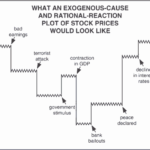
Economists love to talk about exogenous shocks -- events outside of the financial system that cause markets to move. But what if it's just talk and not real at all? Read the rest of this entry »

Robert Prechter on Herding and Markets’ “Irony and Paradox”

Have you ever watched a dog interact with its owner? The dog repeatedly looks at the owner, taking cues constantly. The owner is the leader, and the dog is a pack animal alert for every cue of what the owner wants it to do. Participants in the stock market are doing something similar. They constantly watch their fellows, alert for every clue of what they will do next. The difference is that there is no leader. The crowd is the perceived leader, but it comprises nothing but followers. When there is no leader to set the course, the herd cues only off itself, making the mood of the herd the only factor directing its actions. Read the rest of this entry »
News Feed

Enter your email address to subscribe to this blog and receive notifications of new posts by email.

Archives